Top Scientific Pipette Types Explained for 2026?
In the evolving landscape of laboratory tools, the "scientific pipette" remains essential for precise liquid handling. Dr. Emily Harper, a renowned expert in laboratory instrumentation, emphasizes, “Choosing the right scientific pipette can transform your research outcomes.” This insight underscores the importance of understanding various pipette types as we approach 2026.
Scientific pipettes come in different forms, each designed for specific tasks. Manual pipettes are versatile but may lead to human error if not used correctly. Electronic pipettes simplify the process and ensure accuracy but often require familiarization. The choice affects both the workflow and data reliability, prompting users to reflect on their preferences.
Despite advancements, many scientists overlook the characteristics of their tools. A mismatch in pipette type and application can result in flawed results. As we explore the top scientific pipette types for 2026, a deeper understanding can guide better practices in research laboratories.
Overview of Pipette Types: A Classification for 2026
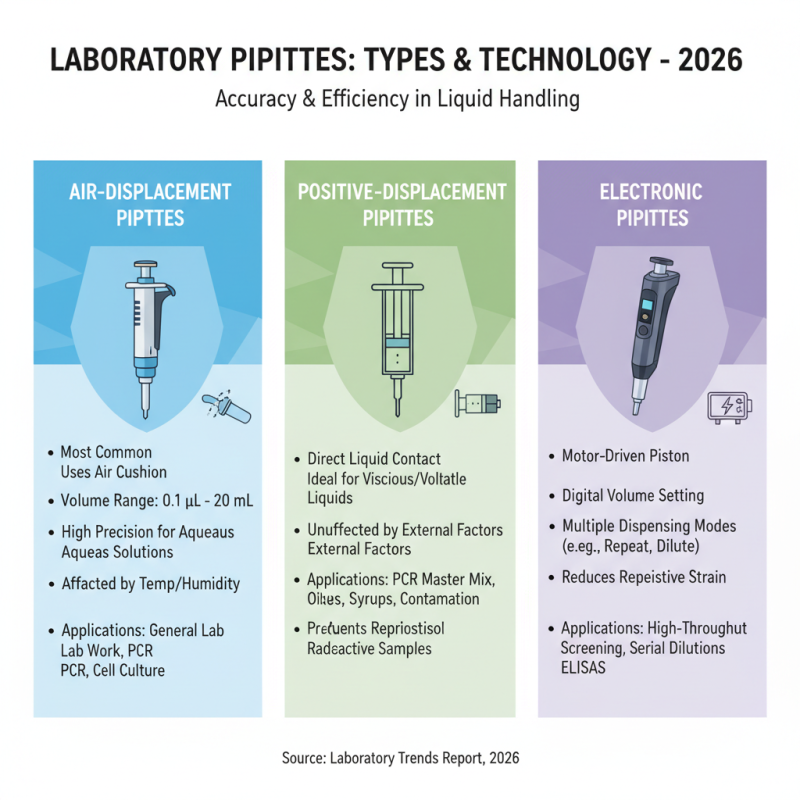
In 2026, understanding the various pipette types is crucial for labs aiming for accuracy and efficiency. Pipettes can be broadly classified into three categories: air-displacement, positive-displacement, and electronic pipettes. Air-displacement pipettes are the most common. They use air pressure to aspirate and dispense liquids. Research indicates that they offer precise volume handling, but their performance can be affected by temperature and humidity.
Positive-displacement pipettes function differently. They directly handle the liquid with a piston. This method minimizes the risk of contamination and is ideal for viscous or volatile liquids. Industry reports suggest they enhance accuracy in challenging environments. However, they require more maintenance than air-displacement types.
Tip: Regular calibration is essential for maintaining pipette accuracy. Research shows that improper calibration can lead to significant variations in liquid handling.
Electronic pipettes provide advanced features like programmable settings and data tracking. They help reduce user fatigue and increase throughput. Yet, they can be complex and require users to undergo proper training. Many labs struggle with the transition to electronic systems.
Tip: Consider user comfort and training resources when selecting a pipette type. This can greatly affect lab productivity.
Key Features of Manual Pipettes: Advantages and Limitations
Manual pipettes are essential tools in laboratories. They offer precision for transferring liquids. Many scientists prefer them for their simplicity. However, using manual pipettes has its pros and cons. They are easy to handle and require minimal training. You can quickly change tips and adjust volumes. This flexibility makes them popular among researchers.
Despite their advantages, manual pipettes have limitations. Accuracy can be affected by user technique. Fatigue might lead to errors over time. Contamination is also a risk if tips are not changed often. The calibration of the pipettes can drift, impacting their performance. It's crucial to regularly check their accuracy to ensure reliable results.
Research indicates that an ideal pipetting technique is not always instinctive. Users might default to less efficient methods. It is vital to regularly review techniques and best practices. Continuous training can help reduce common mistakes. Balancing speed and precision is a constant challenge for many in the lab.
Understanding Electronic Pipettes: Functionality and Benefits
Electronic pipettes have revolutionized laboratory work. These advanced tools allow for precise liquid measurements. Their digital displays make it easy to read values. Scientists can set exact volumes, minimizing human error. This is crucial in experiments where accuracy is paramount.
One standout feature is the programmable settings. Users can customize protocols tailored to specific tasks. This saves time and enhances reproducibility. However, adaptability can sometimes lead to confusion. New users may struggle with the varied functions. Understanding how to navigate these settings takes practice.
Another essential aspect is ergonomics. Electronic pipettes reduce the strain of repetitive tasks. They are lighter and often come with adjustable speeds. Yet, improper grip can lead to discomfort. Training is vital to ensure correct usage. Overall, electronic pipettes present many advantages. They are not without challenges, making user engagement crucial.
Top Scientific Pipette Types Explained for 2026
This chart illustrates the distribution of various pipette types used in scientific laboratories as projected for 2026. Electronic pipettes are expected to have the highest usage percentage at 45%, indicating a shift towards advanced technology in pipetting.
Selecting the Right Pipette for Your Laboratory Needs
Choosing the right pipette for laboratory needs is crucial. An estimated 70% of lab errors stem from inaccurate liquid handling. Understanding pipette types helps mitigate these issues.
A common choice is the air-displacement pipette. It's versatile and ideal for handling small volumes. For tasks requiring high precision, consider electronic pipettes. They offer consistent results but might require more training to use effectively.
Sustainable practices are becoming essential in labs. A recent survey indicated that over 60% of laboratories are shifting towards glass pipettes. They reduce plastic waste significantly. However, glass pipettes can be fragile and may require more careful handling. Adapting to this change can lead to better environmental outcomes.
Mixing pipette types can boost efficiency. Some labs employ a combination of manual and electronic pipettes. This approach can sometimes complicate training and workflow. However, it accommodates various sample types and volumes. Continual assessment of pipette performance ensures that your selections remain optimal for evolving laboratory needs.
Future Trends in Pipette Technology for Enhanced Precision
The evolution of pipette technology is reshaping laboratory practices. In 2026, we can expect significant advancements in design and functionality. Enhanced precision will be the focal point. Innovations may include smart sensors that adapt to various liquid types. These sensors could intuitively adjust settings to ensure accuracy.
Another trend to watch is the integration of digital interfaces. Users may find touchscreens making data entry easier. These features can help eliminate human errors. However, this reliance on technology raises questions. Will the complexity lead to user mistakes instead of reducing them? Also, maintaining technology can be a challenge. Regular updates may become necessary.
Moreover, the materials used in pipette construction are set to improve. New, lightweight materials could enhance comfort during prolonged use. Ergonomic designs will be a priority, helping to prevent hand fatigue. Yet, the focus on aesthetics must not compromise functionality. An oversight here might lead to products that look good but do not perform well. As we look toward the future, balancing innovation with practicality is essential.