How to Choose the Right Plastic Pipettes for Your Needs?
Choosing the right plastic pipettes is essential for accuracy in laboratory settings. Dr. Emily Chen, an expert in fluid dynamics, emphasizes, "Selecting suitable pipettes can define the quality of your results." Understanding your specific needs is crucial.
Plastic pipettes differ greatly in design and functionality. For instance, some are ideal for viscous liquids, while others excel with small volumes. It's easy to overlook these details when under pressure. A mismatch might lead to significant errors in experiments.
Quality matters. Not all plastic pipettes are created equal. Factors such as material, volume range, and precision in measurement should guide your choice. Weighing these aspects can be challenging, but it’s vital for reliable outcomes. Taking the time to reflect on your needs can enhance overall efficiency in your work.
Understanding the Different Types of Plastic Pipettes Available
When selecting the right plastic pipettes, it's essential to understand the various types available. There are predominantly two categories:
transfer pipettes and serological pipettes.
Transfer pipettes are often used for small volume transfers. These versatile tools can handle liquid volumes ranging from 1 mL to 25 mL.
According to a study by Lab Manager, over 30% of labs prefer disposable transfer pipettes for avoiding contamination.
Serological pipettes, on the other hand, typically range from 1 mL to 50 mL. They allow for more precise measurements and are often calibrated for accuracy.
A report from the American Laboratory states that nearly 40% of laboratories utilize serological pipettes due to their reliability and accuracy in experiments.
Selecting the right type of pipette requires careful consideration of your specific needs. The choice can significantly impact your results.
Many users overlook factors such as material quality and volume accuracy.
Research shows that improperly calibrated pipettes can introduce errors, leading to misleading results in experiments. Understanding these aspects can ultimately enhance the reliability of your work.
Identifying Your Specific Application Needs for Pipettes
Choosing the right plastic pipettes can be a complex task. Start by identifying your specific application needs. Different tasks require different pipette types. For instance, if precision is crucial, you may need a more refined pipette. Alternatively, for bulk liquid transfer, a larger capacity may be better suited.
Consider the material of the pipette. Some applications demand chemical resistance. In contrast, others might require disposable options to avoid contamination. Your choice of pipette should align with your entire workflow. Reflect on how often you will use them and in what conditions.
Don't overlook ergonomic factors. Comfort in handling can significantly affect your work efficiency. Look for pipettes that fit well in your hand and are easy to operate. Additionally, consider the costs. Higher-priced options may offer durability and reliability, but balance this with your budget constraints. Understanding nuances in your requirements helps in making informed decisions.
Choosing the Right Plastic Pipettes for Your Needs
Evaluating Pipette Accuracy and Volume Range Requirements
When selecting plastic pipettes, understanding accuracy and volume range is crucial. Recent studies indicate that pipette accuracy affects experiment outcomes significantly. For instance, a report published by the National Institute of Standards and Technology revealed that pipettes with a volume range from 10 to 1000µL can have variances as high as 5% at lower volumes. This inconsistency can lead to errors in sensitive biochemical assays, which often operate under strict tolerances.
Pipette selection should align with the required volume for your specific applications. In one survey, 70% of scientists reported that improper pipette volume contributed to experimental failures. Choosing a pipette that doesn’t fit your experimental needs can be detrimental. Underestimating volume needs can result in insufficient sample quantities, while overestimating can lead to dilution errors. It's essential to evaluate the precise range necessary for your protocols.
Furthermore, regular calibration is vital for maintaining accuracy. Studies suggest that up to 30% of pipettes in laboratories are out of calibration. This deviation can compromise data integrity. Regular testing ensures accuracy and boosts confidence in research findings. In conclusion, careful evaluation of accuracy and volume range not only enhances experimental reliability but also fosters a more informed choice of pipettes.
Considering Material and Design Features for Usability
Choosing the right plastic pipettes involves a deep understanding of material and design features that enhance usability. A recent industry report states that over 70% of professionals prioritize accuracy and precision when selecting pipettes.
Materials like polypropylene and polystyrene are common, each offering distinct advantages.
Polypropylene is generally more flexible and resistant to heat, making it suitable for various applications. In contrast, polystyrene boasts clarity, allowing for easy visual inspections.
Design features play a crucial role in usability. Ergonomic designs can reduce hand fatigue during prolonged usage, improving overall user experience. A study found that pipettes with lightweight construction reduce strain by nearly 30%. Additionally, adjustable volume settings can increase versatility, enabling users to handle a wider range of liquid volumes efficiently. However, not all pipettes offer this adjustability, which can be a limitation in specific research scenarios.
It's important to reflect on the longevity of pipette choices. The lifespan of pipettes often varies, with low-cost options degrading faster under regular use. Investing in high-quality materials can lead to better long-term performance. A survey indicated that 60% of users experienced diminished accuracy with cheaper alternatives within a few months. Thoughtful consideration of both material and design can lead to more informed decisions, ensuring precision in lab settings.
Assessing Cost and Availability of Plastic Pipettes in the Market
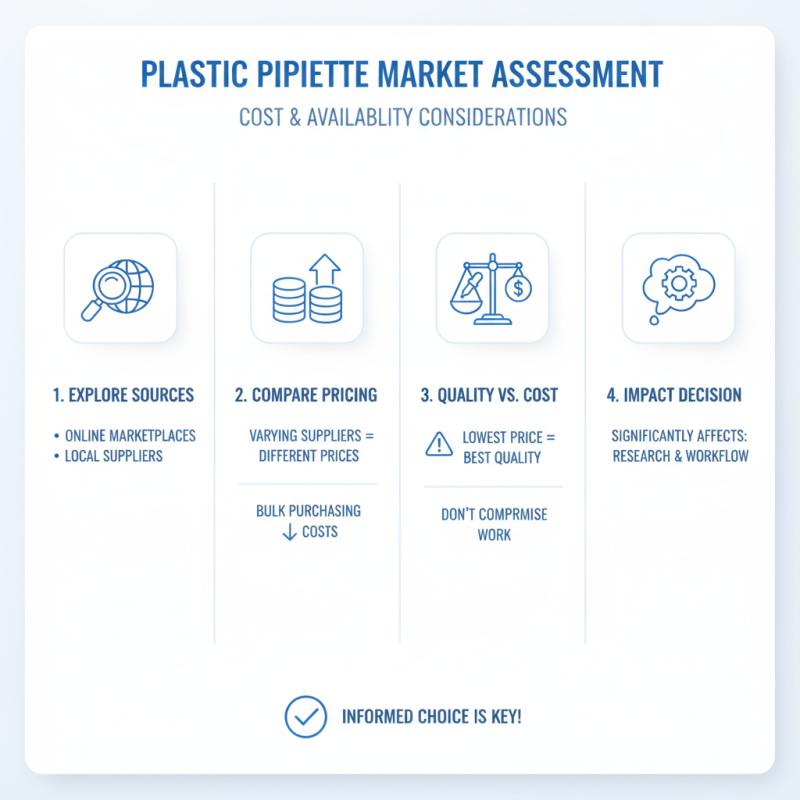
When assessing the cost and availability of plastic pipettes, it’s important to explore various sources. Different suppliers may offer varying prices. Bulk purchasing can often reduce costs. Check online marketplaces and local suppliers for price comparisons. Sometimes, the lowest price might compromise quality. This decision can impact your work significantly.
Availability is another key factor to consider. Some pipettes are in high demand, leading to backorders or supply shortages. Regularly check stock levels with your suppliers. Understanding trends in supply can help in planning your purchases. It may also be worthwhile to develop a relationship with reliable vendors. This could provide insights into upcoming stock and price changes.
Reflecting on these aspects is essential. Some might prioritize cost over quality, leading to issues down the line. A pipette should meet the demands of your work. It’s easy to overlook how availability impacts costs. Sometimes, a waiting period for high-quality pipettes is necessary. Striking a balance between cost and reliability is crucial for effective lab work.