2026 Best Rainin Tips for Global Lab Buyers?
In 2026, global laboratories will evaluate pipette tips beyond price and immediate availability. Rainin tips remain widely considered for liquid-handling accuracy, compatibility, and workflow consistency. Yet purchasing decisions should rely on documented performance, not brand familiarity alone. ISO 8655-2:2022 emphasizes the importance of systematic pipette performance verification, including accuracy and repeatability. These requirements make tip selection a quality decision, not merely a consumables decision.
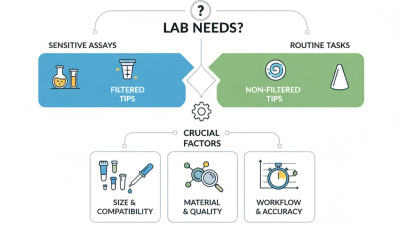
Industry reports support this broader view. Grand View Research’s laboratory consumables analysis identifies rising research activity, clinical testing, and laboratory automation as major market drivers. MarketsandMarkets also reports continued growth in laboratory automation, with interoperability and process reliability becoming stronger purchasing priorities. For global buyers, that means checking whether Rainin tips match the pipette model, robotic deck, liquid type, and local quality procedures. Filtered and low-retention options may reduce contamination risks and sample loss, especially when handling viscous liquids or low-volume assays.
Small details matter.
A buyer should inspect lot traceability, packaging integrity, certification records, and regional supply continuity. A damaged rack or unclear certificate can disrupt an entire testing batch. Sustainability also deserves scrutiny, although marketing claims are not always comparable across suppliers. The 2026 Best Rainin Tips for Global Lab Buyers guide will compare these practical factors across research, clinical, pharmaceutical, and automated workflows. It will also acknowledge an uncomfortable point: the “best” tip may change between laboratories, and published specifications cannot replace local verification. Experience still matters. Careful validation remains essential.

Rainin Tip Formats: Match LTS Compatibility, Volume, and Workflow Needs
Choosing the right LTS-compatible pipette tip starts with fit, not price.
The tip must seat evenly, release cleanly, and prevent wobble during repeated dispensing. ISO 8655-2:2022 emphasizes that pipette performance depends on the complete system, including tips and operating technique. A mismatched tip can quietly increase variation.
Volume matters just as much. For 0.5–10 µL transfers, low-retention tips can reduce liquid left on the wall. For 20–200 µL work, standard tips often provide a better balance between accuracy and cost.
Large-volume tips support faster buffer transfers, but they need sufficient clearance above the vessel bottom. The wrong length causes trouble. It happens.
Industry analyses published by Grand View Research estimate continued growth in laboratory plasticware demand through 2030, driven by molecular testing and automation. That growth makes format standardization more valuable. Use filtered tips for contamination-sensitive workflows, extended-length tips for deep vessels, and sterile packaged formats where sample integrity is critical. Do not assume “universal” means reliable. A 2024 laboratory purchasing report from Lab Manager also highlights workflow efficiency and consumable consistency as major selection factors.
Before bulk purchasing, test several lots with your actual pipettes, liquids, and operators. Record seal quality, ejection force, residual droplets, and dispensing time.
Some tips perform well with water but poorly with viscous reagents. That detail is easy to miss.
Recheck compatibility after changing instruments, because small mechanical differences can affect accuracy and user comfort.
Accuracy Testing: Compare CV and Bias Under ISO 8655-2 Requirements
2026 laboratory buyers should judge pipette accuracy with two numbers: CV and bias. CV measures repeatability, while bias shows closeness to the target volume. A low CV is not enough. A clean CV can still hide bias.
ISO 8655-2:2022 lists maximum permissible errors for piston-operated volumetric apparatus. For a 1,000 µL pipette, the limit is ±8 µL systematic error and 3 µL random error. These values equal 0.8% bias and 0.3% CV. Test results should come from repeated gravimetric measurements, controlled water temperature, and a calibrated balance. Record every individual result, not only the average.
A practical evaluation uses at least ten dispenses at selected volumes, such as 100%, 50%, and 10% of capacity. Calculate CV as standard deviation divided by the mean, then multiply by 100. Calculate bias against the nominal volume. EURAMET cg-19 recommends considering balance resolution, evaporation, temperature, and repeatability in the uncertainty budget. NIST Technical Note 1297 also warns that measurement uncertainty must combine relevant components, rather than relying on one impressive figure. One detail is easy to miss: an instrument may pass at full volume but fail near its lower setting. That is where procurement assumptions need another look.
Contamination Control: Select Filtered and PCR-Grade Tips for Risk Reduction
2026 Best Rainin Tips for Global Lab Buyers?
Contamination control begins with the tip, not the instrument. In routine PCR work, filtered tips help block aerosols from entering the pipette cone. PCR-grade tips add tighter control over nucleases, DNA, RNA, and background residues. These details matter when a faint contamination signal can invalidate an entire plate.
Tips:
Choose tips with documented manufacturing controls and clear lot traceability. Check that the filter is intact, evenly seated, and free from visible damage. Confirm that the tip fits your pipette without excessive force or looseness. Filtered does not always mean sterile, so review the supplier’s exact specifications. For sensitive assays, use unopened racks and change gloves after handling reagents.
Practical testing is still valuable. Run a no-template control beside representative samples during method verification. A clean result once is encouraging, but not conclusive. Repeat the check across different lots when possible. Store racks closed, away from moisture, dust, and strong airflow. Avoid touching rack openings or resting tips on the bench, even briefly. Small habits often decide contamination risk.
Purchasing teams should compare documentation, packaging integrity, fit consistency, and delivery conditions. Lower cost may become expensive after one failed run. I have seen teams focus heavily on tip volume and overlook filter performance. That choice deserves a second look.
Global Compliance: Verify CE-IVDR, FDA, ISO 13485, and Lot Traceability
2026 Best Rainin Tips for Global Lab Buyers?
Global buyers should treat pipette tips as regulated-use supplies, not simple plastic accessories. Confirm whether the product’s intended use falls under CE-IVDR requirements in the destination market. CE marking alone is not enough. Request the declaration of conformity, intended-use statement, risk classification, and supporting technical documents. For United States distribution, check whether FDA registration, listing, clearance, or another pathway applies. Requirements can differ by use, claims, and packaging.
Ask for an ISO 13485 certificate covering the relevant manufacturing site and product scope. Check its validity and certification body details. Do not accept a certificate with unclear scope. Lot traceability should connect each box to resin records, production dates, inspection results, and release approval. A visible lot number on the box helps, but it is only the beginning. Keep samples and records that match the shipment.
Before purchasing, test fit, sealing, leakage, and liquid retention with your actual pipettes. Small variations can affect repeatability. Review sterility claims carefully. Sterile does not automatically mean suitable for every workflow. One practical weakness is relying on copied documents from a distributor. Request current files directly through controlled channels. Also verify label language, storage conditions, transport protection, and change-notification procedures. Some teams overlook these details until a shipment is delayed. That is avoidable, but not always easy.
2026 Global IVD Compliance Verification Checklist
Buyer focus: CE-IVDR, FDA requirements, ISO 13485/QMSR, and lot traceability
The chart shows whether each verification checkpoint is generally applicable when evaluating IVD-related laboratory consumables for the European Union or United States. A value of 100 means the checkpoint is applicable; 0 means it is not the market-specific checkpoint. Actual obligations depend on product classification, intended use, and distribution status.
Reference framework: EU Regulation 2017/746 (IVDR), U.S. FDA device requirements, ISO 13485:2016, and FDA Quality Management System Regulation effective February 2, 2026.
2026 Cost Analysis: Measure Cost per Result, Waste, and Supply Reliability
2026 Best Pipette Tips for Global Lab Buyers
Cost per box is a weak purchasing measure. Cost per reliable result matters more. Calculate tip cost, failed reactions, repeat runs, labor, and disposal fees together. A laboratory may save 8% on tips, then lose more through inconsistent liquid transfer. In procurement reviews, I compare performance across several operators and liquid types. One clean trial is not enough evidence.
Waste deserves a visible number. Track unused tips, rejected plates, clogged tips, and excess packaging each month. Filter compatibility, sealing quality, and low-retention design can reduce material loss. However, “low waste” claims need measured data. We once underestimated waste from oversized racks. The mistake looked small, but annual disposal costs were significant.
Tips: Request samples from at least two suppliers. Test actual workflows, not only water. Record dispensed volume, error rates, operator time, and packaging waste. Ask for lot traceability, quality certificates, production capacity, and realistic lead times. Supply reliability also has a cost. Keep a qualified backup source, especially for imported products and temperature-sensitive shipments. A lower unit price is not useful when a delayed delivery stops a validated process. Recheck the model quarterly. Markets change, and assumptions age quickly.